Showing posts with label History. Show all posts

Saturday, March 13, 2021

How Fascism Works: The Politics of Us and Them


Summary: As the child of refugees of World War II Europe and a renowned philosopher and scholar of propaganda, Jason Stanley has a deep understanding of how democratic societies can be vulnerable to fascism: Nations don’t have to be fascist to suffer from fascist politics. In fact, fascism’s roots have been present in the United States for more than a century. Alarmed by the pervasive rise of fascist tactics both at home and around the globe, Stanley focuses here on the structures that unite them, laying out and analyzing the ten pillars of fascist politics—the language and beliefs that separate people into an “us” and a “them.” He knits together reflections on history, philosophy, sociology, and critical race theory with stories from contemporary Hungary, Poland, India, Myanmar, and the United States, among other nations. He makes clear the immense danger of underestimating the cumulative power of these tactics, which include exploiting a mythic version of a nation’s past; propaganda that twists the language of democratic ideals against themselves; anti-intellectualism directed against universities and experts; law and order politics predicated on the assumption that members of minority groups are criminals; and fierce attacks on labor groups and welfare. These mechanisms all build on one another, creating and reinforcing divisions and shaping a society vulnerable to the appeals of authoritarian leadership.

By uncovering disturbing patterns that are as prevalent today as ever, Stanley reveals that the stuff of politics—charged by rhetoric and myth—can quickly become policy and reality. Only by recognizing fascists politics, he argues, may we resist its most harmful effects and return to democratic ideals.

My Thoughts:

 I found this book to be completely fascinating. It's not very long, and it's a pretty easy read, very accessible and not too philosophical. Simple enough for the average person to comprehend. I just checked out his earlier book "How Propogranda Works" and it is much thicker and denser, so I'm not sure I'll end up slogging through that one. 

I thought this book was really important to read, especially in today's world where most of us can agree that there is a large amount of division going on in our country. The author pointed out how incredibly important it is that we not allow ourselves to get sucked into the "us vs them" rhetoric. I have been worried about that myself, as I have seen a lot of stuff on Facebook and even directly stated by political commentators about how "all" members of certain groups are "evil" "criminals" "rapists" "drug dealers" etc. It's really important to be aware of these tactics so we can prevent truly evil things from happening here in the United States. We have to leave our hearts open with compassion to those who are different from us. There are bad people EVERYWHERE, it's true, but we cannot lump all the bad people into one racial, ethnic, or political group and just be able to make blanket statements that condemn them all. 

Monday, January 11, 2021

Lies My Teacher Told Me: Everything Your American History Textbook Got Wrong


Summary: Americans have lost touch with their history, and in Lies My Teacher Told Me Professor James Loewen shows why. After surveying eighteen leading high school American history texts, he has concluded that not one does a decent job of making history interesting or memorable. Marred by an embarrassing combination of blind patriotism, mindless optimism, sheer misinformation, and outright lies, these books omit almost all the ambiguity, passion, conflict, and drama from our past.

In this revised edition, packed with updated material, Loewen explores how historical myths continue to be perpetuated in today's climate and adds an eye-opening chapter on the lies surrounding 9/11 and the Iraq War. From the truth about Columbus's historic voyages to an honest evaluation of our national leaders, Loewen revives our history, restoring the vitality and relevance it truly possesses.

Thought provoking, nonpartisan, and often shocking, Loewen unveils the real America in this iconoclastic classic beloved by high school teachers, history buffs, and enlightened citizens across the country.

My Thoughts:

I thought this book was fascinating and SO good. I was lucky to have a really great history teacher in high school who did his best to teach us actual history and not just white-washed, feel good history, but there was still so much I didn't know. For example, did you know that Woodrow Wilson was actually super racist, that as President he SEGREGATED areas of government that had previously been integrated? Did you know that at the beginning of post-Civil War Reconstruction, things were actually going pretty well race-relations wise, and Black people were seeing greater equality, until Southern Whites got back the reins and made things awful again? Did you know that Helen Keller as an adult was a strong supporter of socialism? Did you know that Columbus and basically everyone else at the time already knew the earth was round and the whole point of his expedition was to see if he could get rich somewhere? Did you know that the pilgrims likely would not have survived to colonize America if it hadn't been for previous explorers bringing diseases that decimated Native populations? Did you know that the 9/11 terrorist attacks were motivated not because Osama bin Ladin just hates freedom, but as retaliation for what he saw as way too much meddling in the Middle East on the part of America? Did you know that although we like to present the picture of the US being this "international good guy" we've actually stuck our noses where they don't belong many times and completely screwed things up?

I highly recommend reading this book. I thought it was incredibly informative and I think it presented a really important look at how we teach history and how we can do better. I think many of the problems of today stem from a complete lack of accurate understanding of our history. We are taught all our lives half-truths and sometimes outright lies, is it any wonder we still believe them and act as if these things are true (sometimes to our own detriment) as adults? A lot of people think they know history, and they would probably be wrong. Seriously, read this. I am begging you. It was so worth the time. 

Saturday, October 24, 2020

Jefferson's Sons: A Founding Father's Secret Children


Author: Kimberly Brubaker Bradley

 Rating: PG - I feel like this book would be really good for about 7th grade and up. There's nothing overly graphic in it, a man is publicly whipped twice but that's about the extent of the violence. 

Summary:
Beverly, Harriet, Madison, and Eston are Thomas Jefferson's children by one of the people he enslaved, Sally Hemings, and while they do get special treatment - better work, better shoes, even violin lessons - they are still slaves, and are never to mention who their father is. The lighter-skinned children have been promised a chance to escape into white society, but what does this mean for the children who look more like their mother? As each child grows up, their questions about slavery and freedom become tougher, calling into question the real meaning of "life, liberty, and the pursuit of happiness."

Told in three parts from the points of view of three of the children enslaved by Jefferson - Beverly, Madison, and a third boy close to the Hemings family - these engaging and poignant voices shed light on what life was like as one of Jefferson's invisible offspring.

My Thoughts: I LOVED this book. I felt like it did an incredible job addressing the disconnect between Thomas Jefferson, the great patriot and American president who wrote the Declaration of Independence, and Thomas Jefferson, a man who enslaved his fellow human beings. I love how the story was told through the eyes of children, who are trying to understand what slavery means, what freedom means, and why people think it's ok to enslave their fellow human beings. For instance, at one point, the children have a conversation with their mother about whether or not Thomas Jefferson is a good person. They are conflicted, because they can see how he is kind, how much he has done for the country, but they are also living in slavery and they know that is not right. The mother says to them "all of the good things about him - patriot, president, gentleman, educated and intelligent man - those are all true too. he's done many great things. I hope you can be proud of that part of him." But she also tells them that although she has had a very good life, she has never been mistreated and her children are safe "it's not freedom. Sometimes it looks pretty close to freedom. Sometimes it feels okay. Then something happens...and I'm reminded all over again that we live in a prison on this mountain. It's a prison no matter how comfortable it may feel." I thought this was so profound because there is this idea sometimes that "At least some slave owners were nice to the people they enslaved. Some of them were kind." As one of the characters declares in the book, "There isn't such a thing as a nice slave owner. Slavery is bad. It's evil. All slave owners are bad. If a person would own another person, you can't trust a word they'll say."

In another place in the book, two of the boys are looking at the framed Declaration of Independence on the wall in the hallway of the main house, and they read the first lines "We hold these truths to be self-evident, that all men are created equal, that they are endowed by their Creator with certain unalienable Rights, that among these are life, liberty, and the pursuit of happiness." The younger boy is confused. He asks, "If Master Jefferson wrote that, how come he doesn't believe it?" The older boy replies, "He does believe it. At least, he thinks he does." They go on to discuss that the Declaration says "All men" not "all white men" and that self-evident means everyone knows it because it's so obvious. The younger boy says "But people don't know it." The older boy says, "I didn't read it to tell you that. I read it so you'd understand what those two old men (Jefferson and Lafayette) were crying about. They believed this a long time ago, when almost nobody else did, and Master Jefferson wrote it down, and they made a whole new country around it. And now they're so old they're almost dead and they're crying for what they did a long time ago." The younger boy says "But they didn't really do it" and the older replies, "I know. But they think they did." 

There were so many good moments in the book where I had to set it down to ponder for a bit. I thought the author did an excellent job writing this story and helping the reader (via the characters) come to their own conclusion about how to reconcile the amazing things the Founding Fathers did with the fact that many of them were also slave owners. I highly recommend this book.

Monday, September 17, 2018

Roots: The Saga of an American Family

Author: Alex Haley

Pages: 729

Rating: PG-13 (Very intense scenes of violence, rape, and obviously, the N-word is scattered through practically every page of the last 2/3 of this book.)

Summary:
"Early in the spring of 1750, in the village of Juffure, four days upriver from the coast of The Gambia, West Africa, a man-child was born to Omoro and Binta Kinte."

So begins Roots, one of the most extraordinary and influential books of our time. Through the story of one family—his family—Alex Haley unforgettably brings to life the monumental two-century drama of Kunta Kinte and the six generations who came after him: slaves and freedmen, farmers and blacksmiths, lumber mill workmen and Pullman porters, lawyers and architects...and one author.

A national and international phenomenon at the time of its original publication, Roots continues to enthrall readers with its masterful narrative drive and exceptional emotional power, speaking to us all with an undiminished resonance and relevance.

"In all of us there is a hunger, marrow deep, to know our heritage.... Without this enriching knowledge, there is a hollow yearning no matter what our attainments in life."—Alex Haley

My Thoughts: Wow, what a book! I've wanted to read this for a long time and finally dove in. Honestly, the slavery portion of American history is not something I've spent a lot of time reading about. I think mainly because it's so hard to read about something so horrific and immoral happening in your own country. I flew through the beginning part, where Kunta is growing up in Africa, but my reading slowed considerably once he was captured by a slave trader.

I admit, I was shocked by what Kunta had to go through. Although this book is largely a work of fiction (obviously, the author wasn't there and doesn't have any detailed records of words that were actually spoken), Haley tried to make the events as realistic and as historically accurate as possible. And I was appalled. The horrible conditions on the slave ship, the fact that so many of them died before even reaching the US, and then, that they advertised, "Healthy, prime slaves" upon arrival, when in reality, most were horribly emaciated, extremely ill, weak, and covered in sores.

Then, once a slave, treated basically as no more than an animal would be. I learned so much from reading this, and it was so exciting to follow the author's path at the end as he searches out and eventually traces his roots all the way back to the African tribe that Kunta disappeared from back in the 1700's. Due to lack of records and the fact that slaves were bought and sold so frequently (and every time that happened, their last names were changed to their new master's last name), being able to trace a family all the way back to Africa is probably a unique occurance.

I was incredibly humbled by my reading of this book. Especially to note how religious the slaves generally were. They led terrible lives, and yet they clung to God sometimes more fiercely than their "Christian" owners. I also feel deeply grateful that I grew up in a time and place where I literally don't even remember noticing that some people have a different color skin than me. Looking back on my childhood, I can't remember a single instance where I thought less of someone because they didn't look like me. Roots doesn't go into much detail into the lives of the author's ancestors after they were officially freed from slavery after the civil war. But as we all know, the fight for freedom was far from over. We are still battling racism in so many ways, but it sure is amazing to see how far we've come. I was amazed to read that even many abolitionists, who felt that the slaves should be freed, did not believe that blacks and whites could live together in harmony, and many favored shipping all the freed slaves back to Africa.

This book was definitely an epic, but so worth the read!

Tuesday, May 1, 2018

Winter Garden

Author: Kristin Hannah

Pages: 391

Rating: PG-13 (There is some language, some sex is discussed as well. Mostly, it's just a very mature subject matter, I would rate it high school and above.)

Summary:
Meredith and Nina Whitson are as different as sisters can be. One stayed at home to raise her children and manage the family business; the other followed a dream and traveled the world to become a famous photojournalist. But when their beloved father falls ill, these two estranged sisters will find themselves together again, standing alongside their disapproving mother, Anya, who even now offers no comfort to her daughters. On his deathbed, their father extracts a promise: Anya will tell her daughters a story; it is one she began years ago and never finished. This time she will tell it all the way to the end. The tale their mother tells them is unlike anything they’ve heard before—a captivating, mysterious love story that spans more than sixty years and moves from frozen, war-torn Leningrad to modern-day Alaska. Nina’s obsession to uncover the truth will send them all on an unexpected journey into their mother’s past, where they will discover a secret so shocking, it shakes the foundation of their family and changes who they believe they are.

My Thoughts: A good historical fiction novel always leads me to do my own research on the time period to learn more than I could from the book. This novel was no exception. I found myself on Google many times during and after my reading, looking up pictures, stories, facts, etc. This book is about Stalin - controlled Russia going into World War II, specifically the siege of Leningrad. I knew next to nothing about this subject before I started reading. Now, my curiosity has been awakened and I want to learn more!  I knew Stalin was bad, but I never really knew HOW bad. I had never read any accounts of what happened. Although this book is a work of fiction, it is historically accurate as far as the author could make it, and many (if not almost all) of Anya's experiences are things that happened to real people.

This book was truly moving, inspiring, all the other really good words you can use to describe a book. It was thought-provoking and it caused me to ponder and reflect on my life experiences and how they related to the lives of the characters. I almost always put this book down with a profound feeling of gratitude for the freedoms and luxuries I enjoy just because I live in the United States in the 21st Century.

This book is also about forgiveness, understanding, and being unafraid to love. It was just so so good. Highly recommend it.

Tuesday, November 28, 2017

And There Was Light

Author: Jaques Lusseyran

Pages: 282

Rating: PG (there is no language and he doesn't even ever get super descriptive about violence either. However, this is definitely an adult book because the writing is too...dense? for a younger audience. It's very deep and intense)

Summary:
When Jacques Lusseyran was an eight-year-old Parisian schoolboy, he was blinded in an accident. He finished his schooling determined to participate in the world around him. In 1941, when he was seventeen, that world was Nazi-occupied France. Lusseyran formed a resistance group with fifty-two boys and used his heightened senses to recruit the best. Eventually, Lusseyran was arrested and sent to the Buchenwald concentration camp in a transport of two thousand resistance fighters. He was one of only thirty from the transport to survive. His gripping story is one of the most powerful and insightful descriptions of living and thriving with blindness, or indeed any challenge, ever published.

My Thoughts: I found this book...a little tough to get through. There is very little dialogue, and some of the philosophical ideas the author expounds upon went a bit over my head. The story was very interesting, that's for sure, but I felt like he spent way too much time on his childhood and very few pages on his work with the Resistance and subsequent imprisonment. I did enjoy the many reflections on how although he could not see with his eyes, he could still see in many other ways, and most of the time he did not consider himself handicapped at all. I think his general attitude about life is incredibly admirable and worth emulating. He also was one who survived the concentration camps by focusing on helping others instead of on his own difficulties. He fully believed in God the entire time, and realized the importance of just letting each moment of life be what it is and just accepting it.

I think in order to get the full effect of this book you have to pause a lot to reflect on what has just been said. It's not a book you can just read through quickly (like I did). It was definitely a different perspective than I have read before though and was very good!


Friday, March 10, 2017

The Boys in the Boat: Nine Americans and Their Epic Quest for Gold at the 1936 Berlin Olympics

Author: Daniel James Brown
Pages: 370
Rating: G - no language or sex.

Summary:
It was an unlikely quest from the start. With a team composed of the sons of loggers, shipyard workers, and farmers, the University of Washington’s eight-oar crew team was never expected to defeat the elite teams of the East Coast and Great Britain, yet they did, going on to shock the world by defeating the German team rowing for Adolf Hitler. The emotional heart of the tale lies with Joe Rantz, a teenager without family or prospects, who rows not only to regain his shattered self-regard but also to find a real place for himself in the world. Drawing on the boys’ own journals and vivid memories of a once-in-a-lifetime shared dream, Brown has created an unforgettable portrait of an era, a celebration of a remarkable achievement, and a chronicle of one extraordinary young man’s personal quest.

My Thoughts: I have to be honest, I think I would have enjoyed this a lot more if I actually liked rowing as a sport. That being said, this book is written in a way that by the end of it, you totally DO care about rowing! Not that I would probably watch it on purpose but I definitely cared about these boys from Washington and how things were going for them. I loved that this book mainly focuses on Joe Rantz, and the difficulties he had to go through growing up, and how that translated into his rowing success. I think it's amazing to read books like these because Americans today mostly don't have that stamina. They aren't willing to work so hard. There was a lot of background history in the book too on the Depression and what was going on in Germany at the time. I find history to be very interesting, so I found this book fascinating because of the history aspect, and I was never bored. It's a true underdog story too, so that's always fun. By the time the boys got to their gold medal race, even though as a reader you already know the outcome, you find yourself wondering how in the world they manage to pull this off? It seems highly unlikely given the circumstances they boys find themselves in by race time. Give this one a read. It's educational, interesting, and inspiring.

Thursday, November 10, 2016

Behind Every Great Man: The Forgotten Women Behind the World's Famous and Infamous

Author: Marlene Wagman-Geller
Pages: 329
Rating: PG-13 (a few of the people profiled were very sexually open and into drugs, etc. But there is no language)

Summary:
From ancient times to the present, men have gotten most of the good ink. Yet standing just outside the spotlight are the extraordinary, and overlooked, wives and companions who are just as instrumental in shaping the destinies of their famous―and infamous―men.
This witty, illuminating book reveals the remarkable stories of forty captivating females, from Constance Lloyd (Mrs. Oscar Wilde) to Carolyn Adams (Mrs. Jerry Garcia), who have stood behind their legendary partners and helped to humanize them, often at the cost of their own careers, reputations, and happiness. Through fame and its attendant ills―alcoholism, infidelity, mental illness, divorce, and even attempted murder―these powerful women quietly propelled their men to the top and changed the course of history.
Meet the Untold Half of History, Including:
•Alma Reville (Mrs. Alfred Hitchcock)
•Elena Diakonova (Mrs. Salvador Dali)
•Winifred Madikizela (Mrs. Nelson Mandela)
•Ann Charteris (Mrs. Ian Fleming, a.k.a. Mrs. James Bond)
•Ruth Alpern (Mrs. Bernie Maddoff)
And 35 more!

My Thoughts: I felt that this book was really very interesting. I loved learning about the women behind some of these famous men. My favorites were Mrs. GandhiMrs. Schindler, and Mrs. Charlie Chaplin. I had no idea that Gandhi's wife fasted right alongside him, and usually was imprisoned with him as well. Schindler's famous list was a joint brainstorm between husband and wife. You always just kind of think of these men as single, you never consider that they had wife who was just as much involved in their rise to fame! Each chapter is only 4-5 pages long, so it's easy to read small pieces at a time. My biggest complaint is that sometimes the sentence structure is awkward, occasionally there's a phrase that doesn't seem to fit within a given paragraph, and it's a little disjointed. The author tends to jump from topic to topic without smooth transitions. I got a little lost more than once. Other than that, this was an informative, fun read.

Wednesday, March 23, 2016

Call The Midwife: Farewell to the East End

Author: Jennifer Worth
Pages: 314
Rating: PG-13 (a few of the stories are rather mature in nature)

Summary:
Call the Midwife: Farewell to the East End is the last book in Worth's memoir trilogy, which the Times Literary Supplement described as "powerful stories with sweet charm and controlled outrage" in the face of dire circumstances.
Here, at last, is the full story of Chummy's delightful courtship and wedding. We also meet Megan'mave, identical twins who share a browbeaten husband, and return to Sister Monica Joan, who is in top eccentric form. As in Worth's first two books, Call the Midwife: A Memoir of Birth, Joy, and Hard Times and Call the Midwife: Shadows of the Workhouse, the vividly portrayed denizens of a postwar East End contend with the trials of extreme poverty—unsanitary conditions, hunger, and disease—and find surprising ways to thrive in their tightly knit community.

My Thoughts:  This was probably my least favorite of the three books, although I still found it very interesting. It was neat to hear what happened to each of the people the author worked with (Trixie, Chummy, Cynthia, and the nuns) and in case you care, almost none of them do what the show says they do, but we expect television to take some liberties with the storyline. This book was my least favorite because it seemed to be just made up of stories that didn't fit into the first two books, so it's kind of sporadic. But still interesting. This book includes the stories of Meg and Mave, twins who are married to the same man and who insist on following extremely old books about pregnancy and birth; the story of the woman who after finding out she is pregnant yet again with a child they can't afford gets a backstreet abortion and almost dies, the woman who naturally births triplets, The Master's Arms (old guy who is sick and has lost his entire family except one daughter, who comes to nurse him), and the story of the ship's woman who ends up pregnant (this one and the abortion story are particularly disturbing).

I have to say though, that in the end I highly recommend all three of these books. I wish there were more!


Friday, March 11, 2016

Call the Midwife: Shadows of the Workhouse

Author: Jennifer Worth
Pages: 293
Rating: PG
Summary:
The sequel to Jennifer Worth's New York Times bestselling memoir and the basis for the PBS series Call the Midwife
When twenty-two-year-old Jennifer Worth, from a comfortable middle-class upbringing, went to work as a midwife in the direst section of postwar London, she not only delivered hundreds of babies and touched many lives, she also became the neighborhood's most vivid chronicler. Woven into the ongoing tales of her life in the East End are the true stories of the people Worth met who grew up in the dreaded workhouse, a Dickensian institution that limped on into the middle of the twentieth century.
Orphaned brother and sister Peggy and Frank lived in the workhouse until Frank got free and returned to rescue his sister. Bubbly Jane's spirit was broken by the cruelty of the workhouse master until she found kindness and romance years later at Nonnatus House. Mr. Collett, a Boer War veteran, lost his family in the two world wars and died in the workhouse.
Though these are stories of unimaginable hardship, what shines through each is the resilience of the human spirit and the strength, courage, and humor of people determined to build a future for themselves against the odds. This is an enduring work of literary nonfiction, at once a warmhearted coming-of-age story and a startling look at people's lives in the poorest section of postwar London.
My Thoughts: This book was considerably more depressing than the first one, and much less about midwifery. In fact, I don't think there was much mention of birth at all in this book. It was much more concerned with the history of the poor in London, which was horrible by the way! Workhouses were the governments form of "caring" for the destitue, but in reality it was worse than death for many. Some people actually committed suicide to avoid the workhouse. Widows who had no other choice but to enter the workhouse with their entire family were immediately separated from their children, and they often never saw them again. The discipline was harsh and unmerciful...young children were severely beaten for the smallest infractions. I couldn't believe such a thing even existed!

The book is split into three main topics - the workhouse, the scandal of one of the nuns being put on trial for shoplifting, and then the story of an old man named Mr. Collett, who served in the army, barely survived, and then lost his entire family in World War II. I thought each of the stories was just fascinating, and I particularly was impressed with Mr. Collett, who is unfailingly grateful for what he has. He lives in deep poverty, but talks about how it is such a luxury that he has a roof over his head, a bed to sleep in and food to eat. He has hope that he will see his wife and children again soon He's truly an inspiring man and his story is touching.

Worth makes the point in this book that we rarely ever hear the stories of the desperately poor from this time period,  and they are so humbling. I am overwhelmingly grateful that such issues are no longer a part of our daily lives. I sped through this book in just a few days, I found it so fascinating and it just opened my eyes to how much people have suffered throughout history, even in times of peace.

Saturday, March 5, 2016

Call The Midwife

Author: Jennifer Worth
Pages: 319
Rating: PG-13 (There are a few chapters about a prostitute who ended up pregnant, and some of the descriptions of the prostitute life are quite graphic.)

Summary: In the 1950s, twenty-two-year-old Jenny Lee leaves her comfortable home to move into a convent and become a midwife in London's East End slums. While delivering babies all over the city, Jenny encounters a colorful cast of women—from the plucky, warm-hearted nuns with whom she lives, to the woman with twenty-four children who can't speak English, to the prostitutes of the city's seedier side.

My Thoughts: I've been totally addicted to the TV show on Netflix, and knowing it's based on a memoir, I decided to check it out. Guess what? This is just the first of THREE books! Which is awesome because when I finished it I was disappointed that it ended so soon! I found this book to be completely fascinating, especially because these midwives were pioneers in the work of taking care of pregnant women. It's amazing what they were able to do.

Not all the stories are about babies and pregnant women and it's really interesting to read about some of the history of the area. I was particularly struck by the descriptions of the workhouses, which is where the desperately poor used to turn when they had no other choice. The workhouses were honestly not much better than Hitler's concentration camps. Families were separated and children usually died. Seriously so depressing.

If you've been watching the show, you'll recognize the majority of the stories, although some of them don't end quite as happily, which is a bummer. Reading it makes one grateful for all the advances in medicine and laws that we have today that make things even better for mothers.

Highly recommend this one, especially if you're already watching the show!

Thursday, May 28, 2015

Unbroken: A World War II Story of Survival, Resilience, and Redemption

Author: Laura Hillenbrand
Pages: 406
Rating: PG-13 (It's war. It's graphic. It's violent. It's mature. However, there is another version of this book that is written specifically with a teen audience in mind, if you want your kid to read it but don't think they can handle this version.)

Summary:
In boyhood, Louis Zamperini was an incorrigible delinquent. As a teenager, he channeled his defiance into running, discovering a prodigious talent that had carried him to the Berlin Olympics. But when World War II began, the athlete became an airman, embarking on a journey that led to a doomed flight on a May afternoon in 1943. When his Army Air Forces bomber crashed into the Pacific Ocean, against all odds, Zamperini survived, adrift on a foundering life raft. Ahead of Zamperini lay thousands of miles of open ocean, leaping sharks, thirst and starvation, enemy aircraft, and, beyond, a trial even greater. Driven to the limits of endurance, Zamperini would answer desperation with ingenuity; suffering with hope, resolve, and humor; brutality with rebellion. His fate, whether triumph or tragedy, would be suspended on the fraying wire of his will.

My Thoughts: This book was FASCINATING! In the author's note at the end, Hillenbrand makes the point that when we learn about WWII in school, the main focus is on the European war, which is kind of strange considering that it was Japan's attack on Pearl Harbor that got the US into the war, and our atomic bomb drops on Japan that finally and officially ended the ordeal. How come we never really learn about the war in the Pacific? I had no idea all the crazy stuff that was going on. I mean, yes, Hitler and his minions were pure evil and they were doing terrible things, but crazy crap was going down in Japan and the Pacific Islands too. Here are some amazing things I learned that just shocked me.

1. "Between November 1943 and May 1945, 70% of the men listed as killed in action died in operational aircraft accidents, not as a result of enemy action." How sad is that? We lost tens of thousands of men before they even left for foreign soil, just in training accidents or routine practice flights. The book says that in the air corps, 35,946 men died in non-battle situations. So, so sad.

2. Being in the air corps back then was basically signing your own death sentence. An airman was required to fulfill 40 missions before finishing their tour of duty. There was a 50% chance of being killed before completing that tour.

3. Japan was a BRUTAL enemy. Their prison camps I think were actually worse than Hitler's concentration camps. Although Japan didn't have gas chambers in which they routinely gassed prisoners, they did have doctors conducting gruesome medical experiments on prisoners, and they had something called the "kill-all order." If it looked like the Allied forces were getting close to whatever island a Japanese POW camp was located on, the guards would murder every single prisoner. And in several camps, that's exactly what they did, sometimes in gruesome and sadistic ways.

Louie (from the book) made it farther than most airmen that crashed in the ocean. He survived being adrift at sea for over a month. But then he got stuck in a POW camp, and your chances of survival there were slim to none. One particular guard was so brutal that he would beat men until they passed out, then revive them by throwing water on their faces or patting their foreheads with a damp cloth, and then continue the beatings. Another time, when Louie was caught for a minor infraction, this guard required all the prisoners to punch Louie square in the face. If the prisoner did not punch hard enough, he had to keep punching until this guard was satisfied with the force. The only thing that saved Louie from the "kill-all" policy was the atomic bomb. The war ended just weeks before the prisoners in Louie's camp had been told they would all be executed.

It's just an incredible story, and I think everyone needs to read it. These men went through so much, and it continued after the war. We know a lot more about PTSD now than they did back then, and these poor men suffered without relief. Many turned to alcoholism or drugs. Some committed suicide. The war did not end in their minds and in their dreams. I can't even imagine having to go through such a difficult trial.

And we as Americans currently have no idea what it's like to be in such a crisis. We don't know what it's like to have everything rationed, because the war is taking over every resource. Back then, almost every family in America had lost a father, son, brother, uncle, or cousin to the war. I sincerely hope we never have to go through something like that again. But, we need to not forget what those people suffered. And Louie's story is repeated over and over again for each of the thousands of men that suffered through WWII, whether they survived or not. We don't even know the stories of many of the men who died, what horrors they experienced. It's very humbling.

As I said, I was thrilled to discover that there is another version of this book written especially for teens/young adults. I would highly recommend that to you if you have a teenager or if you just don't want to invest yourself in this longer version. But seriously, read it. It's incredible.

Tuesday, April 29, 2014

Edith's Story

Author: Edith Velmans
Pages: 239
Rating: PG - Edith never goes to any of the camps and doesn't have to witness many horrors
Summary:
In 1940, while the Germans occupied Holland, fourteen-year-old Edith van Hessen was filling her diary with the intimate, carefree details of a typical teenager's life — thoughts about boys, school, her family, her friends, her future. By 1942, as Edith was contemplating her first kiss, the Germans had begun to escalate their war against the Jews. Soon this bright, fun-loving girl was grappling with one of the most unfathomable events in human history. Edith's family — assimilated Dutch Jews — were caught in the cross fire of the Holocaust, and Edith began a bitter struggle to survive.

In this extraordinary work, Edith Velmans weaves together revealing entries from her diaries with reminiscences and letters smuggled between family members during the occupation. Edith's Story stands as a profoundly important addition to the literature of the Holocaust, documenting one girl's grief, loss, courage, and ultimate triumph over devastating tyranny and despair. For as Edith is hidden in plain sight by a Christian family, we witness how a young woman must deny, bargain with, and finally face the horrors of war — and how, confronting evil as a child, Edith survives to become an extraordinary woman.

My Thoughts: Edith Van Hessen has been called "The Anne Frank who lived." I felt like this was a very fitting description for her because, like Anne Frank, Edith kept a diary for a large part of the war, and she was also extremely optimistic. There's a quote from Anne Frank's diary where she says something about how she strives to see the good in everything and everyone, and that's very much how Edith was. She did her best to keep a sunny outlook and cheerful disposition, trying to find the best in every situation, no matter how difficult her life became.

I personally loved this book because it was so different from the other Holocaust survival stories I've read. Edith and her familiy had managed to secure visas to America before the Nazis occupied Holland, but they didn't leave because they were unable to get a visa for their grandmother and they couldn't bear to leave her. Edith had two older brothers, and it was decided that the oldest would go. Edith is hidden with a friend's family, in plain sight. She is explained to the neighbors as a family friend who came to visit just for the summer, but then her parents were both in the hospital, so they couldn't bear to send her home. No one suspects a thing, and Edith survives without any difficulties. However, she goes through the guilt and the horror of surviving and living just fine when her family members are having to deal with unkown horrors. She has no idea what is happening to them, and will not find out about it until after the war is over.

I really just enjoyed this book a lot. It was amazing to see how Edith refused to succumb to hoplessness and despair even when everything around her was crumbling. She kept her head up and rarely asked "why me?" It was inspirational.

Monday, March 17, 2014

The Book Thief

Author: Markus Zusak
Pages: 550
Rating: PG
Summary:
It is 1939. Nazi Germany. The country is holding its breath. Death has never been busier, and will become busier still.

Liesel Meminger is a foster girl living outside of Munich, who scratches out a meager existence for herself by stealing when she encounters something she can’t resist–books. With the help of her accordion-playing foster father, she learns to read and shares her stolen books with her neighbors during bombing raids as well as with the Jewish man hidden in her basement.

My Thoughts: First of all, whether you've seen the movie or not, GO READ THIS BOOK! I have not seen the movie, but I already know I don't have to see it to know the book is absolutely worth reading. This is one of those books that while the story itself is moving and captivating, you read the book for the way it is written. Zusak is a master of figurative language, and he spins sentences so beautiful you have to read them twice just to make sure you are absorbing the full meaning of it.

"The words were on their way, and when they arrived, Leisel would hold them in her hands like the clouds, and she would wring them out like the rain."
"Two giant words were struggled with, carried on her shoulder, and dropped as a bungling pair at Ilsa Hermann's feet. They fell off sideways as the girl veered with them and could no longer sustain their weight. Together, they sat on the floor, large and loud and clumsy."
"The reply floated from his mouth, then molded itself like a stain to the ceiling. Such was his feeling of shame."
"The guilt was already there. It was moist. The seed was already bursting into a dark-leafed flower."
"Her nerves licked her palms."
"The wind showered through her hair. Her feet swam with the pedals."
"A graze struck a match on the side of her face, where she'd met the ground. Her pulse flipped it over, frying it on both sides."

See what I mean? You just can't get that from a movie. It's incredible. As for the actual story - I really enjoyed reading about World War Two from the perspective of a young, relatively safe German girl, whose family ends up hiding a Jew. She and her best friend end up really hating Hitler, because their lives are miserable. They are poor, hungry, and their fathers are forced into service because they don't always agree with everything the Nazis say. Leisel is a foster child, who watched her brother die on the train on the way to her foster parents' house in another part of Germany. When she arrives, she does not know how to read, but her foster father Hans painstakingly teaches her until she is obsessed with books and reading. She lives an extremely difficult life, but in the process she learns kindness, love, and selflessness. She never buys in to the German propaganda that Jews are the enemy. After all, the Jew they are hiding in the basement has become one of her closest friends.

Another favorite thing about this book is that Death is the narrator. It's a different perspective that's for sure. He is not vindictive or gleeful. He is simply an observer, and he sometimes is quite sorrowful at all he is required to observe. He says that war is not his friend. It is more like a boss that keeps demanding that you work even harder than you ever have before, and is never pleased with your performance. Also, Death doesn't believe in suspense. He pretty much tells you the ending multiple times before it happens. The ending isn't important, it's the journey to get there that he wants to tell.

This is one of the best books I've ever read. Don't just watch the movie. You MUST read this book. It's incredible.

Saturday, February 22, 2014

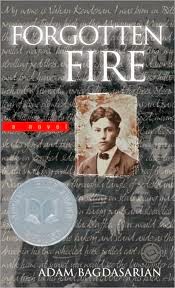
Forgotten Fire

Author: Adam Bagdasarian
Pages: 272
Rating: PG-13 (this is similar to a holocaust novel...it's really intense and a lot of bad stuff happens.)

Summary:
In 1915 Vahan Kenderian is living a life of privilege as the youngest son of a wealthy Armenian family in Turkey. This secure world is shattered when some family members are whisked away while others are murdered before his eyes.

Vahan loses his home and family, and is forced to live a life he would never have dreamed of in order to survive. Somehow Vahan’s incredible strength and spirit help him endure, even knowing that each day could be his last.

My Thoughts: Wow. This book is written as a fiction novel, but nearly everything that happens in it really did happen to someone, and the main character, Vahan, is the author's great-uncle. So don't think you're just reading a made-up story. It's largely a non-fiction book. Twenty years prior to the Jewish Holocaust that everyone knows about, was the Armenian genocide in Turkey. I had never ever heard of this, and after doing a little more research, I learned why. Turkey spent years denying that this genocide ever happened, and the US, in order to maintain a good relationship with Turkey, pretty much agreed not to make it public. Look up "1915 Armenian Genocide" on Google and you will learn tons. It was fascinating.

Basically, Armenians were Christians, and they lived in an Islamic country, Turkey. And in 1915, some new Turks took over the government and decided that Armenians were a threat to the country and must all be exterminated. So began a calculated genocide. It's estimated that half of the Armenian population in Turkey was murdered during this period. It was customary to shoot the oldest Armenian boys right in front of their families.

Vahan comes from a wealthy Armenian family, but within a matter of days, his father, two oldest brothers, and and older sister are all dead, and the rest of his family is on a death march. Vahan and another older brother manage to escape, but they eventually are separated, and Vahan has to survive based on only his own wit and strength. That he manages it is a miracle in and of itself. He meets some kind individuals who protect him, for seemingly no true reason.

I would recommend this book just as an education. Like I said, everyone knows about the Jewish Holocaust, but I had never heard of the Armenian one. Apparently, Hitler actually used the Armenian genocide as justification for what he was about to do to the Jews. At the beginning of the book there is a quote from Hitler, "Who does now remember the Armenians?" He figured that since no one really remembered what happened to the Armenian people, no one would remember the Jews either once he got rid of them. And that's why it's important to learn about the bad things that happened in our histories, so that they won't be repeated.

Friday, January 24, 2014

Miracles and Massacres: True and Untold Stories of the Making of America

Author: Glenn Beck (in case you couldn't tell since his name is twice as big as the title....it annoys me when authors do that)
Pages: 256
Rating: PG-13 (the title tells you why. Massacres)

Summary:
Thomas Edison was a bad guy— and bad guys usually lose in the end.

World War II radio host “Tokyo Rose” was branded as a traitor by the U.S. government and served time in prison. In reality, she was a hero to many.

Twenty U.S. soldiers received medals of honor at the Battle of Wounded Knee—yet this wasn’t a battle at all; it was a massacre.

Paul Revere’s midnight ride was nothing compared to the ride made by a guy named Jack whom you’ve probably never heard of.

History is about so much more than memorizing facts. It is, as more than half of the word suggests, about the story. And, told in the right way, it is the greatest one ever written: Good and evil, triumph and tragedy, despicable acts of barbarism and courageous acts of heroism.

The things you’ve never learned about our past will shock you. The reason why gun control is so important to government elites can be found in a story about Athens that no one dares teach. Not the city in ancient Greece, but the one in 1946 Tennessee. The power of an individual who trusts his gut can be found in the story of the man who stopped the twentieth hijacker from being part of 9/11. And a lesson on what happens when an all-powerful president is in need of positive headlines is revealed in a story about eight saboteurs who invaded America during World War II.

Miracles and Massacres is history as you’ve never heard it told. It’s incredible events that you never knew existed. And it’s stories so important and relevant to today that you won’t have to ask, Why didn’t they teach me this? You will instantly know. If the truth shall set you free, then your freedom begins on page one of this book. By the end, your understanding of the lies and half-truths you’ve been taught may change, but your perception of who we are as Americans and where our country is headed definitely will.

My Thoughts: I thought this book was fascinating. If you like history at all, you'll enjoy this collection of stories as well. They are written as stories, not a collection of facts, and if you really care, at the end of the book, Beck lists which parts of the stories were fabricated for the sake of creating a coherent story line, and which parts are solid fact. I appreciated this, and thought it was pretty interesting.  

My husband didn't like the fact that each story is told from varying viewpoints, and it switches back and forth. I didn't mind it, but just wanted to put that out there.

Personally I learned quite a bit about history from this book, and how the US is certainly not perfect. That being said, I don't think Beck was trying to turn our country into some secretive bad guy, I just think he wanted to expose stories that the government tried to hide or at least gloss over for a while. There are also several stories about bravery and heroism that you just may not have heard of.

My personal favorite story was "Saboteurs: In a Time of War, the Laws are Silent." During World War II, Germany decided to send 8 "spies" over to America to bomb some key factories and bridges and hopefully make things more difficult for the US. The Nazis chose these "spies" based on the fact that they had previously spent time in the United States and would easily blend in to the environment. Unfortunately, they didn't think to check the loyalties of these men, who had no intention of following through with their mission. After a Nazi sub dropped the men off a few miles off the US coastline in the middle of the night, one of the men went straight to the FBI and told them everything, including that he and his comrades had no hard feelings towards the US and that they would like to help the US win the war. However, the United States felt that its citizens needed the morale boost from hearing that 8 would-be saboteurs were captured and kept from their mission. The men were arrested and put in prison, and ultimately, 6 were executed, including one man who was actually a US citizen. The other two were sentenced to 30 years in prison, but only served about 6 of those years. The war ended and a new president freed them and sent them back to Germany.

To me, the ultimate lesson I gained from this book is that you can't always trust every news story or press release you hear. People in power are very good at twisting the truth and convincing unsuspecting listeners that an entirely different truth exists. In at least two of the stories, the American people were convinced that the government was doing the right thing, blissfully unaware of the truth.

But you may get a different message. Like I said, not all the stories are about mistakes. I would give this one a read. It's very interesting, and a pretty easy read too, since the stories are told in a novelistic fashion.