Author: Kristin Hannah
Pages: 391
Rating: PG-13 (There is some language, some sex is discussed as well. Mostly, it's just a very mature subject matter, I would rate it high school and above.)
Summary:
Meredith and Nina Whitson are as different as sisters can be. One stayed
at home to raise her children and manage the family business; the other
followed a dream and traveled the world to become a famous
photojournalist. But when their beloved father falls ill, these two
estranged sisters will find themselves together again, standing
alongside their disapproving mother, Anya, who even now offers no
comfort to her daughters. On his deathbed, their father extracts a
promise: Anya will tell her daughters a story; it is one she began years
ago and never finished. This time she will tell it all the way to the
end. The tale their mother tells them is unlike anything they’ve heard
before—a captivating, mysterious love story that spans more than sixty
years and moves from frozen, war-torn Leningrad to modern-day Alaska.
Nina’s obsession to uncover the truth will send them all on an
unexpected journey into their mother’s past, where they will discover a
secret so shocking, it shakes the foundation of their family and changes
who they believe they are.
My Thoughts: A good historical fiction novel always leads me to do my own research on the time period to learn more than I could from the book. This novel was no exception. I found myself on Google many times during and after my reading, looking up pictures, stories, facts, etc. This book is about Stalin - controlled Russia going into World War II, specifically the siege of Leningrad. I knew next to nothing about this subject before I started reading. Now, my curiosity has been awakened and I want to learn more! I knew Stalin was bad, but I never really knew HOW bad. I had never read any accounts of what happened. Although this book is a work of fiction, it is historically accurate as far as the author could make it, and many (if not almost all) of Anya's experiences are things that happened to real people.
This book was truly moving, inspiring, all the other really good words you can use to describe a book. It was thought-provoking and it caused me to ponder and reflect on my life experiences and how they related to the lives of the characters. I almost always put this book down with a profound feeling of gratitude for the freedoms and luxuries I enjoy just because I live in the United States in the 21st Century.
This book is also about forgiveness, understanding, and being unafraid to love. It was just so so good. Highly recommend it.
Showing posts with label War. Show all posts
Tuesday, May 1, 2018
Tuesday, November 28, 2017
And There Was Light
Author: Jaques Lusseyran
Pages: 282
Rating: PG (there is no language and he doesn't even ever get super descriptive about violence either. However, this is definitely an adult book because the writing is too...dense? for a younger audience. It's very deep and intense)
Summary:
When Jacques Lusseyran was an eight-year-old Parisian schoolboy, he was blinded in an accident. He finished his schooling determined to participate in the world around him. In 1941, when he was seventeen, that world was Nazi-occupied France. Lusseyran formed a resistance group with fifty-two boys and used his heightened senses to recruit the best. Eventually, Lusseyran was arrested and sent to the Buchenwald concentration camp in a transport of two thousand resistance fighters. He was one of only thirty from the transport to survive. His gripping story is one of the most powerful and insightful descriptions of living and thriving with blindness, or indeed any challenge, ever published.
My Thoughts: I found this book...a little tough to get through. There is very little dialogue, and some of the philosophical ideas the author expounds upon went a bit over my head. The story was very interesting, that's for sure, but I felt like he spent way too much time on his childhood and very few pages on his work with the Resistance and subsequent imprisonment. I did enjoy the many reflections on how although he could not see with his eyes, he could still see in many other ways, and most of the time he did not consider himself handicapped at all. I think his general attitude about life is incredibly admirable and worth emulating. He also was one who survived the concentration camps by focusing on helping others instead of on his own difficulties. He fully believed in God the entire time, and realized the importance of just letting each moment of life be what it is and just accepting it.
I think in order to get the full effect of this book you have to pause a lot to reflect on what has just been said. It's not a book you can just read through quickly (like I did). It was definitely a different perspective than I have read before though and was very good!
Pages: 282
Rating: PG (there is no language and he doesn't even ever get super descriptive about violence either. However, this is definitely an adult book because the writing is too...dense? for a younger audience. It's very deep and intense)
Summary:
When Jacques Lusseyran was an eight-year-old Parisian schoolboy, he was blinded in an accident. He finished his schooling determined to participate in the world around him. In 1941, when he was seventeen, that world was Nazi-occupied France. Lusseyran formed a resistance group with fifty-two boys and used his heightened senses to recruit the best. Eventually, Lusseyran was arrested and sent to the Buchenwald concentration camp in a transport of two thousand resistance fighters. He was one of only thirty from the transport to survive. His gripping story is one of the most powerful and insightful descriptions of living and thriving with blindness, or indeed any challenge, ever published.
My Thoughts: I found this book...a little tough to get through. There is very little dialogue, and some of the philosophical ideas the author expounds upon went a bit over my head. The story was very interesting, that's for sure, but I felt like he spent way too much time on his childhood and very few pages on his work with the Resistance and subsequent imprisonment. I did enjoy the many reflections on how although he could not see with his eyes, he could still see in many other ways, and most of the time he did not consider himself handicapped at all. I think his general attitude about life is incredibly admirable and worth emulating. He also was one who survived the concentration camps by focusing on helping others instead of on his own difficulties. He fully believed in God the entire time, and realized the importance of just letting each moment of life be what it is and just accepting it.
I think in order to get the full effect of this book you have to pause a lot to reflect on what has just been said. It's not a book you can just read through quickly (like I did). It was definitely a different perspective than I have read before though and was very good!
Friday, August 4, 2017
Ender's Game
Author: Orson Scott Card
Pages: 368
Rating: PG, some mild language, some violence.
Summary:
In order to develop a secure defense against a hostile alien race's next attack, government agencies breed child geniuses and train them as soldiers. A brilliant young boy, Andrew "Ender" Wiggin lives with his kind but distant parents, his sadistic brother Peter, and the person he loves more than anyone else, his sister Valentine. Peter and Valentine were candidates for the soldier-training program but didn't make the cut--young Ender is the Wiggin drafted to the orbiting Battle School for rigorous military training.
Ender's skills make him a leader in school and respected in the Battle Room, where children play at mock battles in zero gravity. Yet growing up in an artificial community of young soldiers, Ender suffers greatly from isolation, rivalry from his peers, pressure from the adult teachers, and an unsettling fear of the alien invaders. His psychological battles include loneliness, fear that he is becoming like the cruel brother he remembers, and fanning the flames of devotion to his beloved sister.
Is Ender the general Earth needs? But Ender is not the only result of the genetic experiments. The war with the Buggers has been raging for a hundred years, and the quest for the perfect general has been underway for almost as long. Ender's two older siblings are every bit as unusual as he is, but in very different ways. Between the three of them lie the abilities to remake a world. If the world survives, that is.
My Thoughts: I have NOT seen the movie, but I know they changed it quite a bit. This is just my review of the book. I really enjoyed reading it. I got sucked in right away and wanted to know what was happening next and how everything connected. The only thing that was difficult for me was that Ender is supposed to be 6 at the beginning, and although he does age throughout the book, for most of it, he's still under the age of 12. He is supposed to be a child genius, but I still struggled imagining him and his companions that young. I mainly imagined teenagers. I guess just because child warfare is so difficult to imagine.
Since I feel like I'm behind the 8-ball in reading this book, I don't know what else to say about it, only that it was original and different, and I think the argument was there for allowing children to be children, no matter how brilliant they may be.
Pages: 368
Rating: PG, some mild language, some violence.
Summary:
In order to develop a secure defense against a hostile alien race's next attack, government agencies breed child geniuses and train them as soldiers. A brilliant young boy, Andrew "Ender" Wiggin lives with his kind but distant parents, his sadistic brother Peter, and the person he loves more than anyone else, his sister Valentine. Peter and Valentine were candidates for the soldier-training program but didn't make the cut--young Ender is the Wiggin drafted to the orbiting Battle School for rigorous military training.
Ender's skills make him a leader in school and respected in the Battle Room, where children play at mock battles in zero gravity. Yet growing up in an artificial community of young soldiers, Ender suffers greatly from isolation, rivalry from his peers, pressure from the adult teachers, and an unsettling fear of the alien invaders. His psychological battles include loneliness, fear that he is becoming like the cruel brother he remembers, and fanning the flames of devotion to his beloved sister.
Is Ender the general Earth needs? But Ender is not the only result of the genetic experiments. The war with the Buggers has been raging for a hundred years, and the quest for the perfect general has been underway for almost as long. Ender's two older siblings are every bit as unusual as he is, but in very different ways. Between the three of them lie the abilities to remake a world. If the world survives, that is.
My Thoughts: I have NOT seen the movie, but I know they changed it quite a bit. This is just my review of the book. I really enjoyed reading it. I got sucked in right away and wanted to know what was happening next and how everything connected. The only thing that was difficult for me was that Ender is supposed to be 6 at the beginning, and although he does age throughout the book, for most of it, he's still under the age of 12. He is supposed to be a child genius, but I still struggled imagining him and his companions that young. I mainly imagined teenagers. I guess just because child warfare is so difficult to imagine.
Since I feel like I'm behind the 8-ball in reading this book, I don't know what else to say about it, only that it was original and different, and I think the argument was there for allowing children to be children, no matter how brilliant they may be.
Wednesday, November 23, 2016
The Lake House
Author: Kate Morton
Pages: 492
Rating: PG (a few mild swear words, but that's really it.)
Summary:
Living on her family’s idyllic lakeside estate in Cornwall, England, Alice Edevane is a bright, inquisitive, and precociously talented sixteen-year-old who loves to write stories.
One midsummer’s eve, after a beautiful party drawing hundreds of guests to the estate has ended, the Edevanes discover that their youngest child, eleven-month-old Theo, has vanished without a trace. He is never found, and the family is torn apart, the house abandoned.
Decades later, Alice is living in London, having enjoyed a long successful career as a novelist. Miles away, Sadie Sparrow, a young detective in the London police force, is staying at her grandfather’s house in Cornwall. While out walking one day, she stumbles upon the old Edevane estate—now crumbling and covered with vines. Her curiosity is sparked, setting off a series of events that will bring her and Alice together and reveal shocking truths about a past long gone...yet more present than ever.
My Thoughts: Initially, I felt like the pace of this novel was too slow. It is, after all, quite long. I admit, I skimmed through to the end to find out whodunnit, and for some reason, that helped me have the patience to start back and the beginning and actually read. I was glad I did, because there was a lot more to the story than I had gleaned from my skim-through. One thing I liked about this novel is that even though it's mainly told from the perspective of Sadie and Alice, most of the other important characters, including Baby Theo, get a chance to voice their thoughts for a few pages. Also, the summary doesn't tell you, but Sadie is staying in Cornwall on a sort of unofficial leave of absence. She refused to let a police case go, even after it was formally closed. This case continues to gnaw at her, and is eventually solved along with the Edevane case, which is very satisfying.
I loved that this book kept me guessing. There are many times when it seems so clear what is happening, only to be proven wrong a few pages later. The whole event (the disappearance of the boy) is much, much more complicated than anyone originally assumed. Love, honor, keeping promises, war, a secret affair, etc. It's all part of it. I added the label of Historical Fiction to this post because World War I and the "shell shock" the soldiers experienced plays an important role in the storyline. And just so you know, Sadie does manage to uncover exactly what happened to Baby Theo, but I won't tell you what it was. That part was a surprise, even though I already knew who was responsible and why, from my look-ahead. If you like a good mystery, you may want to pick this one up.
Pages: 492
Rating: PG (a few mild swear words, but that's really it.)
Summary:
Living on her family’s idyllic lakeside estate in Cornwall, England, Alice Edevane is a bright, inquisitive, and precociously talented sixteen-year-old who loves to write stories.
One midsummer’s eve, after a beautiful party drawing hundreds of guests to the estate has ended, the Edevanes discover that their youngest child, eleven-month-old Theo, has vanished without a trace. He is never found, and the family is torn apart, the house abandoned.
Decades later, Alice is living in London, having enjoyed a long successful career as a novelist. Miles away, Sadie Sparrow, a young detective in the London police force, is staying at her grandfather’s house in Cornwall. While out walking one day, she stumbles upon the old Edevane estate—now crumbling and covered with vines. Her curiosity is sparked, setting off a series of events that will bring her and Alice together and reveal shocking truths about a past long gone...yet more present than ever.
My Thoughts: Initially, I felt like the pace of this novel was too slow. It is, after all, quite long. I admit, I skimmed through to the end to find out whodunnit, and for some reason, that helped me have the patience to start back and the beginning and actually read. I was glad I did, because there was a lot more to the story than I had gleaned from my skim-through. One thing I liked about this novel is that even though it's mainly told from the perspective of Sadie and Alice, most of the other important characters, including Baby Theo, get a chance to voice their thoughts for a few pages. Also, the summary doesn't tell you, but Sadie is staying in Cornwall on a sort of unofficial leave of absence. She refused to let a police case go, even after it was formally closed. This case continues to gnaw at her, and is eventually solved along with the Edevane case, which is very satisfying.
I loved that this book kept me guessing. There are many times when it seems so clear what is happening, only to be proven wrong a few pages later. The whole event (the disappearance of the boy) is much, much more complicated than anyone originally assumed. Love, honor, keeping promises, war, a secret affair, etc. It's all part of it. I added the label of Historical Fiction to this post because World War I and the "shell shock" the soldiers experienced plays an important role in the storyline. And just so you know, Sadie does manage to uncover exactly what happened to Baby Theo, but I won't tell you what it was. That part was a surprise, even though I already knew who was responsible and why, from my look-ahead. If you like a good mystery, you may want to pick this one up.
Friday, November 18, 2016
Moon Over Manifest
Author: Clare Vanderpool
Pages: 342
Rating: G
Summary:
Abilene Tucker feels abandoned. Her father has put her on a train, sending her off to live with an old friend for the summer while he works a railroad job. Armed only with a few possessions and her list of universals, Abilene jumps off the train in Manifest, Kansas, aiming to learn about the boy her father once was.
Having heard stories about Manifest, Abilene is disappointed to find that it’s just a dried-up, worn-out old town. But her disappointment quickly turns to excitement when she discovers a hidden cigar box full of mementos, including some old letters that mention a spy known as the Rattler. These mysterious letters send Abilene and her new friends, Lettie and Ruthanne, on an honest-to-goodness spy hunt, even though they are warned to “Leave Well Enough Alone.”
Abilene throws all caution aside when she heads down the mysterious Path to Perdition to pay a debt to the reclusive Miss Sadie, a diviner who only tells stories from the past. It seems that Manifest’s history is full of colorful and shadowy characters—and long-held secrets. The more Abilene hears, the more determined she is to learn just what role her father played in that history. And as Manifest’s secrets are laid bare one by one, Abilene begins to weave her own story into the fabric of the town.
My Thoughts: This is a children's novel, suitable for elementary through middle school age students. I thought it was interesting, but the Rattler didn't play nearly enough of a role in the story, and ended up not being very important in the end anyway. Abilene seemed to be on a much bigger quest to learn about her father and the history of the town, which you get in snippets from Miss Sadie. What I did love is the historical fiction part of the book. The history of Manifest involves a lot of immigrants and World War One as well as lots of information about Prohibition and bootlegging. In the end, the book is really all about a 12 year old girl, trying to find a home for herself. I enjoyed it, but didn't feel it was super memorable.
Pages: 342
Rating: G
Summary:
Abilene Tucker feels abandoned. Her father has put her on a train, sending her off to live with an old friend for the summer while he works a railroad job. Armed only with a few possessions and her list of universals, Abilene jumps off the train in Manifest, Kansas, aiming to learn about the boy her father once was.
Having heard stories about Manifest, Abilene is disappointed to find that it’s just a dried-up, worn-out old town. But her disappointment quickly turns to excitement when she discovers a hidden cigar box full of mementos, including some old letters that mention a spy known as the Rattler. These mysterious letters send Abilene and her new friends, Lettie and Ruthanne, on an honest-to-goodness spy hunt, even though they are warned to “Leave Well Enough Alone.”
Abilene throws all caution aside when she heads down the mysterious Path to Perdition to pay a debt to the reclusive Miss Sadie, a diviner who only tells stories from the past. It seems that Manifest’s history is full of colorful and shadowy characters—and long-held secrets. The more Abilene hears, the more determined she is to learn just what role her father played in that history. And as Manifest’s secrets are laid bare one by one, Abilene begins to weave her own story into the fabric of the town.
My Thoughts: This is a children's novel, suitable for elementary through middle school age students. I thought it was interesting, but the Rattler didn't play nearly enough of a role in the story, and ended up not being very important in the end anyway. Abilene seemed to be on a much bigger quest to learn about her father and the history of the town, which you get in snippets from Miss Sadie. What I did love is the historical fiction part of the book. The history of Manifest involves a lot of immigrants and World War One as well as lots of information about Prohibition and bootlegging. In the end, the book is really all about a 12 year old girl, trying to find a home for herself. I enjoyed it, but didn't feel it was super memorable.
Saturday, August 15, 2015
All the Light We Cannot See
Author: Anthony Doerr
Pages: 530
Rating: PG-13 (There is a little bit of language from soldiers, and a group of girls gets raped by Russian soldiers near the end, but the description is very vague)
Summary:
Marie-Laure lives with her father in Paris near the Museum of Natural History, where he works as the master of its thousands of locks. When she is six, Marie-Laure goes blind and her father builds a perfect miniature of their neighborhood so she can memorize it by touch and navigate her way home. When she is twelve, the Nazis occupy Paris and father and daughter flee to the walled citadel of Saint-Malo, where Marie-Laure’s reclusive great-uncle lives in a tall house by the sea. With them they carry what might be the museum’s most valuable and dangerous jewel.
In a mining town in Germany, the orphan Werner grows up with his younger sister, enchanted by a crude radio they find. Werner becomes an expert at building and fixing these crucial new instruments, a talent that wins him a place at a brutal academy for Hitler Youth, then a special assignment to track the resistance. More and more aware of the human cost of his intelligence, Werner travels through the heart of the war and, finally, into Saint-Malo, where his story and Marie-Laure’s converge.
My Thoughts: I can't say that this book was life-changing, but it was definitely very interesting and enjoyable to read and it gave me a lot to think about. I felt like the author really knew each of his characters and what they were going through. Sometimes the descriptions of things were confusing and I wasn't exactly sure what he was talking about. I will say that I loved that this is a work of historical fiction that seems as if every sentence could have been fact. I sometimes lost sight of the fact that this was a work of fiction and I wanted to tell people about it as if Werner and Marie-Laure actually lived.
The book is organized into very short, 2-3 page chapters that go back and forth between Marie-Laure's and Werner's perspectives, with an occasional interruption from another minor character. This I liked because it made the book easy to read in quick spurts. The book ALSO jumps back and forth in time. There will be several chapters in a row about the end of the war, and then several chapters in a row about Werner and Marie-Laure's childhood. I didn't feel like this was confusing, however. I kind of liked it.
I think my favorite part of this book was the perspectives it showed. I've read a lot of World War 2 books, both fiction and non-fiction and most of the time, the books I've read focused on those who ended up stuck in Germany's horrific concentration camps. This book tells the story of a young boy forced into service in the German military, and a young, blind, French girl dealing with the occupation of her country. I particularly liked Werner's story. Although fiction, it resonated with truth. Werner is happy that his skill with radios saves him from working in his town mines and allows him to attend an elite school for German youth. However, this school is not without its brutality and cruelty, as the boys are taught to hate any sign of weakness in anyone, even their own countrymen, and to believe wholeheartedly in the superiority of the Aryan race.
When Werner is finally sent to war, his skills with the radio again save him from any real fighting, as he is on a task force that travels through Germany's conquered countries and tracks down any illegal radio transmissions. Whenever they find anyone with an illegal radio that they are using to broadcast information, they kill them. Werner voices his discomfort about this, since he has been taught that these people are all ruthless terrorists and highly organized criminals, but all he ever sees are simple people in simple dwellings. I just loved that this book portrayed the fact that war is a terrible tragedy for everyone involved, no matter which side you are on. Not all Germans were bad. Not all German soldiers believed in what they were fighting for.
The ending of this book was sad, and surprising. I didn't think it was going to end in the way it did. But I feel like it was very realistic. War devastates countries and lives, and you just do the best you can to keep moving, to keep living and I felt like that's what the ending of this book portrayed. I would definitely recommend this book if you are interested in history.
Pages: 530
Rating: PG-13 (There is a little bit of language from soldiers, and a group of girls gets raped by Russian soldiers near the end, but the description is very vague)
Summary:
Marie-Laure lives with her father in Paris near the Museum of Natural History, where he works as the master of its thousands of locks. When she is six, Marie-Laure goes blind and her father builds a perfect miniature of their neighborhood so she can memorize it by touch and navigate her way home. When she is twelve, the Nazis occupy Paris and father and daughter flee to the walled citadel of Saint-Malo, where Marie-Laure’s reclusive great-uncle lives in a tall house by the sea. With them they carry what might be the museum’s most valuable and dangerous jewel.
In a mining town in Germany, the orphan Werner grows up with his younger sister, enchanted by a crude radio they find. Werner becomes an expert at building and fixing these crucial new instruments, a talent that wins him a place at a brutal academy for Hitler Youth, then a special assignment to track the resistance. More and more aware of the human cost of his intelligence, Werner travels through the heart of the war and, finally, into Saint-Malo, where his story and Marie-Laure’s converge.
My Thoughts: I can't say that this book was life-changing, but it was definitely very interesting and enjoyable to read and it gave me a lot to think about. I felt like the author really knew each of his characters and what they were going through. Sometimes the descriptions of things were confusing and I wasn't exactly sure what he was talking about. I will say that I loved that this is a work of historical fiction that seems as if every sentence could have been fact. I sometimes lost sight of the fact that this was a work of fiction and I wanted to tell people about it as if Werner and Marie-Laure actually lived.
The book is organized into very short, 2-3 page chapters that go back and forth between Marie-Laure's and Werner's perspectives, with an occasional interruption from another minor character. This I liked because it made the book easy to read in quick spurts. The book ALSO jumps back and forth in time. There will be several chapters in a row about the end of the war, and then several chapters in a row about Werner and Marie-Laure's childhood. I didn't feel like this was confusing, however. I kind of liked it.
I think my favorite part of this book was the perspectives it showed. I've read a lot of World War 2 books, both fiction and non-fiction and most of the time, the books I've read focused on those who ended up stuck in Germany's horrific concentration camps. This book tells the story of a young boy forced into service in the German military, and a young, blind, French girl dealing with the occupation of her country. I particularly liked Werner's story. Although fiction, it resonated with truth. Werner is happy that his skill with radios saves him from working in his town mines and allows him to attend an elite school for German youth. However, this school is not without its brutality and cruelty, as the boys are taught to hate any sign of weakness in anyone, even their own countrymen, and to believe wholeheartedly in the superiority of the Aryan race.
When Werner is finally sent to war, his skills with the radio again save him from any real fighting, as he is on a task force that travels through Germany's conquered countries and tracks down any illegal radio transmissions. Whenever they find anyone with an illegal radio that they are using to broadcast information, they kill them. Werner voices his discomfort about this, since he has been taught that these people are all ruthless terrorists and highly organized criminals, but all he ever sees are simple people in simple dwellings. I just loved that this book portrayed the fact that war is a terrible tragedy for everyone involved, no matter which side you are on. Not all Germans were bad. Not all German soldiers believed in what they were fighting for.
The ending of this book was sad, and surprising. I didn't think it was going to end in the way it did. But I feel like it was very realistic. War devastates countries and lives, and you just do the best you can to keep moving, to keep living and I felt like that's what the ending of this book portrayed. I would definitely recommend this book if you are interested in history.
Thursday, May 28, 2015
Unbroken: A World War II Story of Survival, Resilience, and Redemption
Author: Laura Hillenbrand
Pages: 406
Rating: PG-13 (It's war. It's graphic. It's violent. It's mature. However, there is another version of this book that is written specifically with a teen audience in mind, if you want your kid to read it but don't think they can handle this version.)
Summary:
In boyhood, Louis Zamperini was an incorrigible delinquent. As a teenager, he channeled his defiance into running, discovering a prodigious talent that had carried him to the Berlin Olympics. But when World War II began, the athlete became an airman, embarking on a journey that led to a doomed flight on a May afternoon in 1943. When his Army Air Forces bomber crashed into the Pacific Ocean, against all odds, Zamperini survived, adrift on a foundering life raft. Ahead of Zamperini lay thousands of miles of open ocean, leaping sharks, thirst and starvation, enemy aircraft, and, beyond, a trial even greater. Driven to the limits of endurance, Zamperini would answer desperation with ingenuity; suffering with hope, resolve, and humor; brutality with rebellion. His fate, whether triumph or tragedy, would be suspended on the fraying wire of his will.
My Thoughts: This book was FASCINATING! In the author's note at the end, Hillenbrand makes the point that when we learn about WWII in school, the main focus is on the European war, which is kind of strange considering that it was Japan's attack on Pearl Harbor that got the US into the war, and our atomic bomb drops on Japan that finally and officially ended the ordeal. How come we never really learn about the war in the Pacific? I had no idea all the crazy stuff that was going on. I mean, yes, Hitler and his minions were pure evil and they were doing terrible things, but crazy crap was going down in Japan and the Pacific Islands too. Here are some amazing things I learned that just shocked me.
1. "Between November 1943 and May 1945, 70% of the men listed as killed in action died in operational aircraft accidents, not as a result of enemy action." How sad is that? We lost tens of thousands of men before they even left for foreign soil, just in training accidents or routine practice flights. The book says that in the air corps, 35,946 men died in non-battle situations. So, so sad.
2. Being in the air corps back then was basically signing your own death sentence. An airman was required to fulfill 40 missions before finishing their tour of duty. There was a 50% chance of being killed before completing that tour.
3. Japan was a BRUTAL enemy. Their prison camps I think were actually worse than Hitler's concentration camps. Although Japan didn't have gas chambers in which they routinely gassed prisoners, they did have doctors conducting gruesome medical experiments on prisoners, and they had something called the "kill-all order." If it looked like the Allied forces were getting close to whatever island a Japanese POW camp was located on, the guards would murder every single prisoner. And in several camps, that's exactly what they did, sometimes in gruesome and sadistic ways.
Louie (from the book) made it farther than most airmen that crashed in the ocean. He survived being adrift at sea for over a month. But then he got stuck in a POW camp, and your chances of survival there were slim to none. One particular guard was so brutal that he would beat men until they passed out, then revive them by throwing water on their faces or patting their foreheads with a damp cloth, and then continue the beatings. Another time, when Louie was caught for a minor infraction, this guard required all the prisoners to punch Louie square in the face. If the prisoner did not punch hard enough, he had to keep punching until this guard was satisfied with the force. The only thing that saved Louie from the "kill-all" policy was the atomic bomb. The war ended just weeks before the prisoners in Louie's camp had been told they would all be executed.
It's just an incredible story, and I think everyone needs to read it. These men went through so much, and it continued after the war. We know a lot more about PTSD now than they did back then, and these poor men suffered without relief. Many turned to alcoholism or drugs. Some committed suicide. The war did not end in their minds and in their dreams. I can't even imagine having to go through such a difficult trial.
And we as Americans currently have no idea what it's like to be in such a crisis. We don't know what it's like to have everything rationed, because the war is taking over every resource. Back then, almost every family in America had lost a father, son, brother, uncle, or cousin to the war. I sincerely hope we never have to go through something like that again. But, we need to not forget what those people suffered. And Louie's story is repeated over and over again for each of the thousands of men that suffered through WWII, whether they survived or not. We don't even know the stories of many of the men who died, what horrors they experienced. It's very humbling.
As I said, I was thrilled to discover that there is another version of this book written especially for teens/young adults. I would highly recommend that to you if you have a teenager or if you just don't want to invest yourself in this longer version. But seriously, read it. It's incredible.
Pages: 406
Rating: PG-13 (It's war. It's graphic. It's violent. It's mature. However, there is another version of this book that is written specifically with a teen audience in mind, if you want your kid to read it but don't think they can handle this version.)
Summary:
In boyhood, Louis Zamperini was an incorrigible delinquent. As a teenager, he channeled his defiance into running, discovering a prodigious talent that had carried him to the Berlin Olympics. But when World War II began, the athlete became an airman, embarking on a journey that led to a doomed flight on a May afternoon in 1943. When his Army Air Forces bomber crashed into the Pacific Ocean, against all odds, Zamperini survived, adrift on a foundering life raft. Ahead of Zamperini lay thousands of miles of open ocean, leaping sharks, thirst and starvation, enemy aircraft, and, beyond, a trial even greater. Driven to the limits of endurance, Zamperini would answer desperation with ingenuity; suffering with hope, resolve, and humor; brutality with rebellion. His fate, whether triumph or tragedy, would be suspended on the fraying wire of his will.
My Thoughts: This book was FASCINATING! In the author's note at the end, Hillenbrand makes the point that when we learn about WWII in school, the main focus is on the European war, which is kind of strange considering that it was Japan's attack on Pearl Harbor that got the US into the war, and our atomic bomb drops on Japan that finally and officially ended the ordeal. How come we never really learn about the war in the Pacific? I had no idea all the crazy stuff that was going on. I mean, yes, Hitler and his minions were pure evil and they were doing terrible things, but crazy crap was going down in Japan and the Pacific Islands too. Here are some amazing things I learned that just shocked me.
1. "Between November 1943 and May 1945, 70% of the men listed as killed in action died in operational aircraft accidents, not as a result of enemy action." How sad is that? We lost tens of thousands of men before they even left for foreign soil, just in training accidents or routine practice flights. The book says that in the air corps, 35,946 men died in non-battle situations. So, so sad.
2. Being in the air corps back then was basically signing your own death sentence. An airman was required to fulfill 40 missions before finishing their tour of duty. There was a 50% chance of being killed before completing that tour.
3. Japan was a BRUTAL enemy. Their prison camps I think were actually worse than Hitler's concentration camps. Although Japan didn't have gas chambers in which they routinely gassed prisoners, they did have doctors conducting gruesome medical experiments on prisoners, and they had something called the "kill-all order." If it looked like the Allied forces were getting close to whatever island a Japanese POW camp was located on, the guards would murder every single prisoner. And in several camps, that's exactly what they did, sometimes in gruesome and sadistic ways.
Louie (from the book) made it farther than most airmen that crashed in the ocean. He survived being adrift at sea for over a month. But then he got stuck in a POW camp, and your chances of survival there were slim to none. One particular guard was so brutal that he would beat men until they passed out, then revive them by throwing water on their faces or patting their foreheads with a damp cloth, and then continue the beatings. Another time, when Louie was caught for a minor infraction, this guard required all the prisoners to punch Louie square in the face. If the prisoner did not punch hard enough, he had to keep punching until this guard was satisfied with the force. The only thing that saved Louie from the "kill-all" policy was the atomic bomb. The war ended just weeks before the prisoners in Louie's camp had been told they would all be executed.
It's just an incredible story, and I think everyone needs to read it. These men went through so much, and it continued after the war. We know a lot more about PTSD now than they did back then, and these poor men suffered without relief. Many turned to alcoholism or drugs. Some committed suicide. The war did not end in their minds and in their dreams. I can't even imagine having to go through such a difficult trial.
And we as Americans currently have no idea what it's like to be in such a crisis. We don't know what it's like to have everything rationed, because the war is taking over every resource. Back then, almost every family in America had lost a father, son, brother, uncle, or cousin to the war. I sincerely hope we never have to go through something like that again. But, we need to not forget what those people suffered. And Louie's story is repeated over and over again for each of the thousands of men that suffered through WWII, whether they survived or not. We don't even know the stories of many of the men who died, what horrors they experienced. It's very humbling.
As I said, I was thrilled to discover that there is another version of this book written especially for teens/young adults. I would highly recommend that to you if you have a teenager or if you just don't want to invest yourself in this longer version. But seriously, read it. It's incredible.
Saturday, March 29, 2014
While We're Far Apart
Author: Lynn Austin
Pages: 408
Rating: PG (nothing is really graphic or too detailed for younger kids, but it is about war, so....)
Summary:
In an unassuming apartment building in Brooklyn, New York, three lives intersect as the reality of war invades each aspect of their lives. Young Esther is heartbroken when her father decides to enlist in the army shortly after the death of her mother. Penny Goodrich has been in love with Eddie Shaffer for as long as she can remember; now that Eddie's wife is dead, Penny feels she has been given a second chance and offers to care for his children in the hope that he will finally notice her and marry her after the war. And elderly Mr. Mendel, the landlord, waits for the war to end to hear what has happened to his son trapped in war torn Hungary. But during the long, endless wait for victory overseas, life on the home front will go from bad to worse. Yet these characters will find themselves growing and changing in ways they never expected and ultimately discovering truths about God's love. . .even when He is silent.
My Thoughts: I really enjoy Lynn Austin's novels. A lot of times Christian novels have that one character who is so annoyingly perfect in their faith that they seem completely unrealistic. And they're constantly reciting phrases like, "Just trust in the Lord, honey, and it will all be fine." Austin's characters are a lot more believable to me, and they also often are struggling with their faith.
But, let me start at the beginning. This book is NOT a love story. Although Penny thinks she is in love with Eddie, she's really not, and the story is more about the children and Mr. Mendel dealing with the difficulties and uncertainties of war than it is about anything else. Mr. Mendel is a Jewish man who has been struggling with his faith. His wife died in a car crash a year ago, and his son is trapped in Europe during the most dangerous time possible. Mr. Mendel doesn't understand why God has allowed such terrible things to happen to him. Soon, Esther and Peter, the children who live upstairs from him, become his friends, and they begin to help each other with their sorrows and problems. I love that the author chose to weave together Mendel's Jewish faith with the childrens' Christian faith. Mr. Mendel tells the children the stories of Esther and Joseph from the Old Testament, helping them to understand that God is working in the background even when it seems he is not there. I loved that Austin brought out the commonalities in the two religions and created a bond between her characters with it.
I happen to love World War II era novels, and this one was another great one. Each character is presented with such clarity and they each have their own obstacle to overcome. Penny, for instance, grew up in a household that was so strict and overprotective, that she has very low self-confidence. Her mother always told her that she was not smart or capable, and is furious with her for deciding to take on the care of Eddie Shaffer's two children. She thinks Penny will not be able to do it. Penny is a great character who gets the opportunity to discover so many things about herself and about life in general once she sets herself free from the prejudices and fears of her parents.
I highly recommend this book. It's just really good, and as is typical of Lynn Austin, the religiousness of the book never feels forced. It just belongs there as naturally as anything.
Pages: 408
Rating: PG (nothing is really graphic or too detailed for younger kids, but it is about war, so....)
Summary:
In an unassuming apartment building in Brooklyn, New York, three lives intersect as the reality of war invades each aspect of their lives. Young Esther is heartbroken when her father decides to enlist in the army shortly after the death of her mother. Penny Goodrich has been in love with Eddie Shaffer for as long as she can remember; now that Eddie's wife is dead, Penny feels she has been given a second chance and offers to care for his children in the hope that he will finally notice her and marry her after the war. And elderly Mr. Mendel, the landlord, waits for the war to end to hear what has happened to his son trapped in war torn Hungary. But during the long, endless wait for victory overseas, life on the home front will go from bad to worse. Yet these characters will find themselves growing and changing in ways they never expected and ultimately discovering truths about God's love. . .even when He is silent.
My Thoughts: I really enjoy Lynn Austin's novels. A lot of times Christian novels have that one character who is so annoyingly perfect in their faith that they seem completely unrealistic. And they're constantly reciting phrases like, "Just trust in the Lord, honey, and it will all be fine." Austin's characters are a lot more believable to me, and they also often are struggling with their faith.
But, let me start at the beginning. This book is NOT a love story. Although Penny thinks she is in love with Eddie, she's really not, and the story is more about the children and Mr. Mendel dealing with the difficulties and uncertainties of war than it is about anything else. Mr. Mendel is a Jewish man who has been struggling with his faith. His wife died in a car crash a year ago, and his son is trapped in Europe during the most dangerous time possible. Mr. Mendel doesn't understand why God has allowed such terrible things to happen to him. Soon, Esther and Peter, the children who live upstairs from him, become his friends, and they begin to help each other with their sorrows and problems. I love that the author chose to weave together Mendel's Jewish faith with the childrens' Christian faith. Mr. Mendel tells the children the stories of Esther and Joseph from the Old Testament, helping them to understand that God is working in the background even when it seems he is not there. I loved that Austin brought out the commonalities in the two religions and created a bond between her characters with it.
I happen to love World War II era novels, and this one was another great one. Each character is presented with such clarity and they each have their own obstacle to overcome. Penny, for instance, grew up in a household that was so strict and overprotective, that she has very low self-confidence. Her mother always told her that she was not smart or capable, and is furious with her for deciding to take on the care of Eddie Shaffer's two children. She thinks Penny will not be able to do it. Penny is a great character who gets the opportunity to discover so many things about herself and about life in general once she sets herself free from the prejudices and fears of her parents.
I highly recommend this book. It's just really good, and as is typical of Lynn Austin, the religiousness of the book never feels forced. It just belongs there as naturally as anything.
Labels:
Christian,
Historical Fiction,
Loss,
Rating: PG,
War,
WWII
Saturday, February 22, 2014
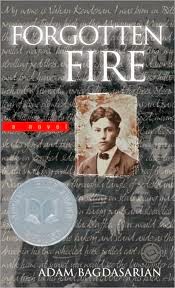
Forgotten Fire
Author: Adam Bagdasarian
Pages: 272
Rating: PG-13 (this is similar to a holocaust novel...it's really intense and a lot of bad stuff happens.)
Summary:
In 1915 Vahan Kenderian is living a life of privilege as the youngest son of a wealthy Armenian family in Turkey. This secure world is shattered when some family members are whisked away while others are murdered before his eyes.
Vahan loses his home and family, and is forced to live a life he would never have dreamed of in order to survive. Somehow Vahan’s incredible strength and spirit help him endure, even knowing that each day could be his last.
My Thoughts: Wow. This book is written as a fiction novel, but nearly everything that happens in it really did happen to someone, and the main character, Vahan, is the author's great-uncle. So don't think you're just reading a made-up story. It's largely a non-fiction book. Twenty years prior to the Jewish Holocaust that everyone knows about, was the Armenian genocide in Turkey. I had never ever heard of this, and after doing a little more research, I learned why. Turkey spent years denying that this genocide ever happened, and the US, in order to maintain a good relationship with Turkey, pretty much agreed not to make it public. Look up "1915 Armenian Genocide" on Google and you will learn tons. It was fascinating.
Basically, Armenians were Christians, and they lived in an Islamic country, Turkey. And in 1915, some new Turks took over the government and decided that Armenians were a threat to the country and must all be exterminated. So began a calculated genocide. It's estimated that half of the Armenian population in Turkey was murdered during this period. It was customary to shoot the oldest Armenian boys right in front of their families.
Vahan comes from a wealthy Armenian family, but within a matter of days, his father, two oldest brothers, and and older sister are all dead, and the rest of his family is on a death march. Vahan and another older brother manage to escape, but they eventually are separated, and Vahan has to survive based on only his own wit and strength. That he manages it is a miracle in and of itself. He meets some kind individuals who protect him, for seemingly no true reason.
I would recommend this book just as an education. Like I said, everyone knows about the Jewish Holocaust, but I had never heard of the Armenian one. Apparently, Hitler actually used the Armenian genocide as justification for what he was about to do to the Jews. At the beginning of the book there is a quote from Hitler, "Who does now remember the Armenians?" He figured that since no one really remembered what happened to the Armenian people, no one would remember the Jews either once he got rid of them. And that's why it's important to learn about the bad things that happened in our histories, so that they won't be repeated.
Pages: 272
Rating: PG-13 (this is similar to a holocaust novel...it's really intense and a lot of bad stuff happens.)
Summary:
In 1915 Vahan Kenderian is living a life of privilege as the youngest son of a wealthy Armenian family in Turkey. This secure world is shattered when some family members are whisked away while others are murdered before his eyes.
Vahan loses his home and family, and is forced to live a life he would never have dreamed of in order to survive. Somehow Vahan’s incredible strength and spirit help him endure, even knowing that each day could be his last.
My Thoughts: Wow. This book is written as a fiction novel, but nearly everything that happens in it really did happen to someone, and the main character, Vahan, is the author's great-uncle. So don't think you're just reading a made-up story. It's largely a non-fiction book. Twenty years prior to the Jewish Holocaust that everyone knows about, was the Armenian genocide in Turkey. I had never ever heard of this, and after doing a little more research, I learned why. Turkey spent years denying that this genocide ever happened, and the US, in order to maintain a good relationship with Turkey, pretty much agreed not to make it public. Look up "1915 Armenian Genocide" on Google and you will learn tons. It was fascinating.
Basically, Armenians were Christians, and they lived in an Islamic country, Turkey. And in 1915, some new Turks took over the government and decided that Armenians were a threat to the country and must all be exterminated. So began a calculated genocide. It's estimated that half of the Armenian population in Turkey was murdered during this period. It was customary to shoot the oldest Armenian boys right in front of their families.
Vahan comes from a wealthy Armenian family, but within a matter of days, his father, two oldest brothers, and and older sister are all dead, and the rest of his family is on a death march. Vahan and another older brother manage to escape, but they eventually are separated, and Vahan has to survive based on only his own wit and strength. That he manages it is a miracle in and of itself. He meets some kind individuals who protect him, for seemingly no true reason.
I would recommend this book just as an education. Like I said, everyone knows about the Jewish Holocaust, but I had never heard of the Armenian one. Apparently, Hitler actually used the Armenian genocide as justification for what he was about to do to the Jews. At the beginning of the book there is a quote from Hitler, "Who does now remember the Armenians?" He figured that since no one really remembered what happened to the Armenian people, no one would remember the Jews either once he got rid of them. And that's why it's important to learn about the bad things that happened in our histories, so that they won't be repeated.
Friday, January 24, 2014
Miracles and Massacres: True and Untold Stories of the Making of America
Author: Glenn Beck (in case you couldn't tell since his name is twice as big as the title....it annoys me when authors do that)
Pages: 256
Rating: PG-13 (the title tells you why. Massacres)
Summary:
Thomas Edison was a bad guy— and bad guys usually lose in the end.
World War II radio host “Tokyo Rose” was branded as a traitor by the U.S. government and served time in prison. In reality, she was a hero to many.
Twenty U.S. soldiers received medals of honor at the Battle of Wounded Knee—yet this wasn’t a battle at all; it was a massacre.
Paul Revere’s midnight ride was nothing compared to the ride made by a guy named Jack whom you’ve probably never heard of.
History is about so much more than memorizing facts. It is, as more than half of the word suggests, about the story. And, told in the right way, it is the greatest one ever written: Good and evil, triumph and tragedy, despicable acts of barbarism and courageous acts of heroism.
The things you’ve never learned about our past will shock you. The reason why gun control is so important to government elites can be found in a story about Athens that no one dares teach. Not the city in ancient Greece, but the one in 1946 Tennessee. The power of an individual who trusts his gut can be found in the story of the man who stopped the twentieth hijacker from being part of 9/11. And a lesson on what happens when an all-powerful president is in need of positive headlines is revealed in a story about eight saboteurs who invaded America during World War II.
Miracles and Massacres is history as you’ve never heard it told. It’s incredible events that you never knew existed. And it’s stories so important and relevant to today that you won’t have to ask, Why didn’t they teach me this? You will instantly know. If the truth shall set you free, then your freedom begins on page one of this book. By the end, your understanding of the lies and half-truths you’ve been taught may change, but your perception of who we are as Americans and where our country is headed definitely will.
My Thoughts: I thought this book was fascinating. If you like history at all, you'll enjoy this collection of stories as well. They are written as stories, not a collection of facts, and if you really care, at the end of the book, Beck lists which parts of the stories were fabricated for the sake of creating a coherent story line, and which parts are solid fact. I appreciated this, and thought it was pretty interesting.
My husband didn't like the fact that each story is told from varying viewpoints, and it switches back and forth. I didn't mind it, but just wanted to put that out there.
Personally I learned quite a bit about history from this book, and how the US is certainly not perfect. That being said, I don't think Beck was trying to turn our country into some secretive bad guy, I just think he wanted to expose stories that the government tried to hide or at least gloss over for a while. There are also several stories about bravery and heroism that you just may not have heard of.
My personal favorite story was "Saboteurs: In a Time of War, the Laws are Silent." During World War II, Germany decided to send 8 "spies" over to America to bomb some key factories and bridges and hopefully make things more difficult for the US. The Nazis chose these "spies" based on the fact that they had previously spent time in the United States and would easily blend in to the environment. Unfortunately, they didn't think to check the loyalties of these men, who had no intention of following through with their mission. After a Nazi sub dropped the men off a few miles off the US coastline in the middle of the night, one of the men went straight to the FBI and told them everything, including that he and his comrades had no hard feelings towards the US and that they would like to help the US win the war. However, the United States felt that its citizens needed the morale boost from hearing that 8 would-be saboteurs were captured and kept from their mission. The men were arrested and put in prison, and ultimately, 6 were executed, including one man who was actually a US citizen. The other two were sentenced to 30 years in prison, but only served about 6 of those years. The war ended and a new president freed them and sent them back to Germany.
To me, the ultimate lesson I gained from this book is that you can't always trust every news story or press release you hear. People in power are very good at twisting the truth and convincing unsuspecting listeners that an entirely different truth exists. In at least two of the stories, the American people were convinced that the government was doing the right thing, blissfully unaware of the truth.
But you may get a different message. Like I said, not all the stories are about mistakes. I would give this one a read. It's very interesting, and a pretty easy read too, since the stories are told in a novelistic fashion.
Pages: 256
Rating: PG-13 (the title tells you why. Massacres)
Summary:
Thomas Edison was a bad guy— and bad guys usually lose in the end.
World War II radio host “Tokyo Rose” was branded as a traitor by the U.S. government and served time in prison. In reality, she was a hero to many.
Twenty U.S. soldiers received medals of honor at the Battle of Wounded Knee—yet this wasn’t a battle at all; it was a massacre.
Paul Revere’s midnight ride was nothing compared to the ride made by a guy named Jack whom you’ve probably never heard of.
History is about so much more than memorizing facts. It is, as more than half of the word suggests, about the story. And, told in the right way, it is the greatest one ever written: Good and evil, triumph and tragedy, despicable acts of barbarism and courageous acts of heroism.
The things you’ve never learned about our past will shock you. The reason why gun control is so important to government elites can be found in a story about Athens that no one dares teach. Not the city in ancient Greece, but the one in 1946 Tennessee. The power of an individual who trusts his gut can be found in the story of the man who stopped the twentieth hijacker from being part of 9/11. And a lesson on what happens when an all-powerful president is in need of positive headlines is revealed in a story about eight saboteurs who invaded America during World War II.
Miracles and Massacres is history as you’ve never heard it told. It’s incredible events that you never knew existed. And it’s stories so important and relevant to today that you won’t have to ask, Why didn’t they teach me this? You will instantly know. If the truth shall set you free, then your freedom begins on page one of this book. By the end, your understanding of the lies and half-truths you’ve been taught may change, but your perception of who we are as Americans and where our country is headed definitely will.
My Thoughts: I thought this book was fascinating. If you like history at all, you'll enjoy this collection of stories as well. They are written as stories, not a collection of facts, and if you really care, at the end of the book, Beck lists which parts of the stories were fabricated for the sake of creating a coherent story line, and which parts are solid fact. I appreciated this, and thought it was pretty interesting.
My husband didn't like the fact that each story is told from varying viewpoints, and it switches back and forth. I didn't mind it, but just wanted to put that out there.
Personally I learned quite a bit about history from this book, and how the US is certainly not perfect. That being said, I don't think Beck was trying to turn our country into some secretive bad guy, I just think he wanted to expose stories that the government tried to hide or at least gloss over for a while. There are also several stories about bravery and heroism that you just may not have heard of.
My personal favorite story was "Saboteurs: In a Time of War, the Laws are Silent." During World War II, Germany decided to send 8 "spies" over to America to bomb some key factories and bridges and hopefully make things more difficult for the US. The Nazis chose these "spies" based on the fact that they had previously spent time in the United States and would easily blend in to the environment. Unfortunately, they didn't think to check the loyalties of these men, who had no intention of following through with their mission. After a Nazi sub dropped the men off a few miles off the US coastline in the middle of the night, one of the men went straight to the FBI and told them everything, including that he and his comrades had no hard feelings towards the US and that they would like to help the US win the war. However, the United States felt that its citizens needed the morale boost from hearing that 8 would-be saboteurs were captured and kept from their mission. The men were arrested and put in prison, and ultimately, 6 were executed, including one man who was actually a US citizen. The other two were sentenced to 30 years in prison, but only served about 6 of those years. The war ended and a new president freed them and sent them back to Germany.
To me, the ultimate lesson I gained from this book is that you can't always trust every news story or press release you hear. People in power are very good at twisting the truth and convincing unsuspecting listeners that an entirely different truth exists. In at least two of the stories, the American people were convinced that the government was doing the right thing, blissfully unaware of the truth.
But you may get a different message. Like I said, not all the stories are about mistakes. I would give this one a read. It's very interesting, and a pretty easy read too, since the stories are told in a novelistic fashion.
Thursday, January 2, 2014
The Guernsey Literary and Potato Peel Pie Society
Author: Mary Ann Shaffer and Annie Barrows
Pages: 274
Rating: PG (It's a post-World War II novel, and some of the wartime descriptions are a little too graphic for it to be rated G)
Summary: January 1946: London is emerging from the shadow of the Second World War, and writer Juliet Ashton is looking for her next book subject. Who could imagine that she would find it in a letter from a man she’s never met, a native of the island of Guernsey, who has come across her name written inside a book by Charles Lamb….
As Juliet and her new correspondent exchange letters, Juliet is drawn into the world of this man and his friends—and what a wonderfully eccentric world it is. The Guernsey Literary and Potato Peel Pie Society—born as a spur-of-the-moment alibi when its members were discovered breaking curfew by the Germans occupying their island—boasts a charming, funny, deeply human cast of characters, from pig farmers to phrenologists, literature lovers all.
Juliet begins a remarkable correspondence with the society’s members, learning about their island, their taste in books, and the impact the recent German occupation has had on their lives. Captivated by their stories, she sets sail for Guernsey, and what she finds will change her forever.
My Thoughts: This book was recommended to me by both my sister and a former roommate, so I knew I had to eventually pick it up. I really enjoyed it! Sometimes I get annoyed with books written entirely in letter format, as this one was, but it really worked for this novel. The worst part is that there are no "chapters" so there's nowhere good to stop! I pretty much binge-read this book. I am already a sucker for novels and books about World War II, so of course, I was automatically interested.
This is a different novel than you have probably ever read about the War. It's all about this eccentric group of friends from a little island off the coast of England, who had to deal with the German Occupation of their Island in the best way they could. They were completely cut off from any news or contact with anyone from mainland England for the entire 4 years the Germans occupied their island. They had very little food, and eventually, the Germans didn't have any either; they were resorting to killing and eating stray dogs and cats. The only thing that kept these island friends sane during this Occupation was their Literary society. They did not have many books (most of the books on the island ended up being burned for fuel after all the wood and other methods of fuel ran out) and some members of the society read the same book over and over again. However, they were able to spend a few hours every few weeks discussing these books and ideas, and forgetting about the war.
I loved this book a lot because it was a simple and easy read, but you really got a feel for these people, who, although fictional, could just as well have been real. It's been so long since we have suffered from such a terrible war that my generation doesn't know what it is like, and we take all of our blessings for granted. For example, just to have good flour and sugar to bake a cake was an unheard-of luxury for most during the dark years of the war. The "Potato Peel Pie" part of the name of the society came because the society wanted to serve refreshments at their meetings. Having no sugar or other such necessities for sweets, a member of the club made up a pie made of mashed potatoes sweetened with strained beets with potato peels for crust.
Another aspect of this book I liked was that the members of the society were able to separate the collective character of the German Army from that of the individual officers. In fact, they made good friends with one officer, who was very friendly, and not at all supportive or pleased with what his country was doing during this war. They also related the small acts of kindness some German soldiers would discreetly and quietly carry out: "accidentally" pushing a few potatoes off the back of a cart for the starving children following behind, delivering desperately needed medicine to a woman with a sick child in the village, helping a man in a churchyard dig a grave.
This one I definitely recommend. I gave it the PG rating because some of the descriptions of wartime activities and the way the Germans treated their prisoners can be intense. Not terribly bad though, and it's not something they dwell on a lot in the book. Happy reading!
Pages: 274
Rating: PG (It's a post-World War II novel, and some of the wartime descriptions are a little too graphic for it to be rated G)
Summary: January 1946: London is emerging from the shadow of the Second World War, and writer Juliet Ashton is looking for her next book subject. Who could imagine that she would find it in a letter from a man she’s never met, a native of the island of Guernsey, who has come across her name written inside a book by Charles Lamb….
As Juliet and her new correspondent exchange letters, Juliet is drawn into the world of this man and his friends—and what a wonderfully eccentric world it is. The Guernsey Literary and Potato Peel Pie Society—born as a spur-of-the-moment alibi when its members were discovered breaking curfew by the Germans occupying their island—boasts a charming, funny, deeply human cast of characters, from pig farmers to phrenologists, literature lovers all.
Juliet begins a remarkable correspondence with the society’s members, learning about their island, their taste in books, and the impact the recent German occupation has had on their lives. Captivated by their stories, she sets sail for Guernsey, and what she finds will change her forever.
My Thoughts: This book was recommended to me by both my sister and a former roommate, so I knew I had to eventually pick it up. I really enjoyed it! Sometimes I get annoyed with books written entirely in letter format, as this one was, but it really worked for this novel. The worst part is that there are no "chapters" so there's nowhere good to stop! I pretty much binge-read this book. I am already a sucker for novels and books about World War II, so of course, I was automatically interested.
This is a different novel than you have probably ever read about the War. It's all about this eccentric group of friends from a little island off the coast of England, who had to deal with the German Occupation of their Island in the best way they could. They were completely cut off from any news or contact with anyone from mainland England for the entire 4 years the Germans occupied their island. They had very little food, and eventually, the Germans didn't have any either; they were resorting to killing and eating stray dogs and cats. The only thing that kept these island friends sane during this Occupation was their Literary society. They did not have many books (most of the books on the island ended up being burned for fuel after all the wood and other methods of fuel ran out) and some members of the society read the same book over and over again. However, they were able to spend a few hours every few weeks discussing these books and ideas, and forgetting about the war.
I loved this book a lot because it was a simple and easy read, but you really got a feel for these people, who, although fictional, could just as well have been real. It's been so long since we have suffered from such a terrible war that my generation doesn't know what it is like, and we take all of our blessings for granted. For example, just to have good flour and sugar to bake a cake was an unheard-of luxury for most during the dark years of the war. The "Potato Peel Pie" part of the name of the society came because the society wanted to serve refreshments at their meetings. Having no sugar or other such necessities for sweets, a member of the club made up a pie made of mashed potatoes sweetened with strained beets with potato peels for crust.
Another aspect of this book I liked was that the members of the society were able to separate the collective character of the German Army from that of the individual officers. In fact, they made good friends with one officer, who was very friendly, and not at all supportive or pleased with what his country was doing during this war. They also related the small acts of kindness some German soldiers would discreetly and quietly carry out: "accidentally" pushing a few potatoes off the back of a cart for the starving children following behind, delivering desperately needed medicine to a woman with a sick child in the village, helping a man in a churchyard dig a grave.
This one I definitely recommend. I gave it the PG rating because some of the descriptions of wartime activities and the way the Germans treated their prisoners can be intense. Not terribly bad though, and it's not something they dwell on a lot in the book. Happy reading!
Tuesday, January 10, 2012
By George, by Wesley Stace
Rating: PG-13 (There is mention of sex, but not really graphically, however, towards the end, quite a few F-words get thrown in there, which was a disappointment.)
Summary: In the illustrious history of the theatrical Fishers, there are two Georges. One is a peculiar but endearing 11-year-old, raised in the seedy world of `70s boarding houses and backstages, now packed off to school for the first time; the other, a garrulous ventriloquist's dummy who belonged to George's grandfather, a favorite traveling act of the British troops in World War II. The two Georges know nothing of each other--until events conspire to unite them in a search to uncover the family's deepest secrets.
Weaving the boy's tale and the puppet's "memoirs," BY GEORGE unveils the fascinating Fisher family--its weak men, its dominant women, its disgruntled boys, and its shocking and dramatic secrets. At once bitingly funny and exquisitely tender, Stace's novel is the unforgettable journey of two young boys separated by years but driven by the same desires: to find a voice, and to be loved.
My Thoughts: Ok, honestly, I was not a huge fan of this book. For the most part, I think it was just too LONG. The story could have been told just as well in probably 150 pages less. There was a lot of pointless filler story in there about day to day life, that I felt just wasn't really necessary to further the story. It took me forever to finish this book because I kept getting frustrated with its lack of direction, so I'd put it down and read something else for a while. I found myself skimming quite a lot as I got towards the end.
There are two mysteries going on in the book and they are solved near the end. George finds out who his real father is (although, I figured it out before he did) and they find out what really happened to his grandpa Joe. Like I said already though, the lead up to finding all this out is just too boring. I felt like the book was also kind of depressing too, as though no one really got what they wanted at the end. It was all just very melancholy. Another problem I had with this book was I had this feeling of disconnect between me and the characters. It sometimes felt as if all the characters in the book were connected and knew what was going on, and they were throwing back and forth little bits of conversation and innuendos that made perfect sense to them, but I was completely out of the loop. I felt a little lost at times. I didn't feel a part of the story really. More of a confused observer.
Overall, I probably would not recommend this book, but if you still think it sounds interesting, go ahead and give it a try.
Wednesday, December 21, 2011
Water Song: A Retelling of "The Frog Prince", by Suzanne Weyn
Pages:194
Rating: PG (there's nothing bad in it, but it does take place during WWI, so it's kind of intense in spots)
Summary:Young, beautiful, and wealthy, Emma Pennington is accustomed to a very comfortable life. Although war rages abroad, she hardly feels its effect. She and her mother travel from their home in Britain to the family estate in Belgium, never imagining that the war could reach them there. But it does.
Soon Emma finds herself stranded in a war-torn country, utterly alone. Enemy troops fight to take over her estate, leaving her with no way to reach her family, and no way out.
With all of her attention focused on survival and escape, Emma hardly expects to find love. But the war will teach her that life is unpredictable, people aren't always what they seem, and magic is lurking everywhere.
My Thoughts: I really liked the way this book was set up. Instead of him being a literal frog, the guy (Jack) is an American soldier from Louisiana who is a really good swimmer and awesome at holding his breath. He only looks like a frog when the two first meet because he has been hit with chlorine gas and his face is covered in boils and stuff. Emma finds him because in his haste to get away from the gas, he falls into a well on her property. It was a creative way to retell the story of the frog prince, and I'm always entertained by World War stories. The whole love part of it all was decidedly cheesy, but what can you expect from a fairy tale?
I think the author tried a little to hard to tie in the whole prince and frog part. If she had just left it alone, I think it would have worked better. Like I said, the ending is really cheesy. But it is intense, seeing as they're basically living as German prisoners since the Germans take over Emma's house. And the book keeps you guessing because Emma has a locket with something inside the second half that is only for an emergency, but she's never been able to get the locket open. So you keep wondering what's in it. I honestly was a bit disappointed by the contents, but....see for yourself.
Rating: PG (there's nothing bad in it, but it does take place during WWI, so it's kind of intense in spots)
Summary:Young, beautiful, and wealthy, Emma Pennington is accustomed to a very comfortable life. Although war rages abroad, she hardly feels its effect. She and her mother travel from their home in Britain to the family estate in Belgium, never imagining that the war could reach them there. But it does.
Soon Emma finds herself stranded in a war-torn country, utterly alone. Enemy troops fight to take over her estate, leaving her with no way to reach her family, and no way out.
With all of her attention focused on survival and escape, Emma hardly expects to find love. But the war will teach her that life is unpredictable, people aren't always what they seem, and magic is lurking everywhere.
My Thoughts: I really liked the way this book was set up. Instead of him being a literal frog, the guy (Jack) is an American soldier from Louisiana who is a really good swimmer and awesome at holding his breath. He only looks like a frog when the two first meet because he has been hit with chlorine gas and his face is covered in boils and stuff. Emma finds him because in his haste to get away from the gas, he falls into a well on her property. It was a creative way to retell the story of the frog prince, and I'm always entertained by World War stories. The whole love part of it all was decidedly cheesy, but what can you expect from a fairy tale?
I think the author tried a little to hard to tie in the whole prince and frog part. If she had just left it alone, I think it would have worked better. Like I said, the ending is really cheesy. But it is intense, seeing as they're basically living as German prisoners since the Germans take over Emma's house. And the book keeps you guessing because Emma has a locket with something inside the second half that is only for an emergency, but she's never been able to get the locket open. So you keep wondering what's in it. I honestly was a bit disappointed by the contents, but....see for yourself.
Subscribe to:
Posts (Atom)